Saturday, September 23, 2023

 It’s been a long while since I wrote something here.

Why?

Because covid happened.  And then an illness that had nothing to do with covid - still haven’t had it/knock on wood - but an illness that almost erased me from the face of the Earth.  Three months in hospital tells you how serious it was; they don’t do that for nothing.

        But enough of that.  Back to France, my Other Country, which I’ve missed horribly.


Eating lunch today, solo, I had time to think.  And my thoughts ran to how things are different at the table between France and the States.

For instance, you’re supposed to finish up the cheese, the bread and the wine at the same time.  That may not sound difficult, but just try it.  You end up either getting very good at it, or eating far more than you’d intended.  It took me years, but I’m very good at it now.  I wonder if my children, born and raised there, find it anything but natural.

And then, in the States, when eating with knife and fork, you cut your meat (or whatever), put your knife down, switch your fork to your other hand (depending on whether you’re right- or left-handed) and eat what you’ve cut.  Then you start all over again.  In Frace, that’s ludicrous.  You don’t change hands with your fork.  But you do eat very gingerly.  And hold your fork and knife in a manner pleasing to the eye.

And then there are the glasses.  Of course, that also exists in fancy American restaurants as well.  There’s the water glass, the red wine glass, the white wine glass, and perhaps Another Glass.  Of course, if you’re a poor student, you’re lucky if you have ONE glass.  Sometimes it’s got a fun image of Astérix le Gaulois, or Boule et Bill, or Gaston la Gaffe on it because it once held French mustard and you’ve recycled it because you can’t afford extravagances like real actual glasses.

        Not to mention cheese.  France has almost 300 types of cheese.  In all shapes and sizes.  General de Gaulle himself - hero of World War II and President of France - once said, “How can anyone govern a country with 246 varieties of cheese?”  So knowing how to cut the various shapes correctly to put a piece on your plate really weeds the men from the boys.

These are only four of the pitfalls of sitting down at a French table.

That being said, French food is so good that you really shouldn’t care.  And the French are too polite to tell you you’re a slob anyway, so...

So go to France.  Have a meal with friends.  Enjoy it all.  You’ll never regret it.

Tuesday, April 27, 2021

LE LAPIN DE PAQUES


Moving to a new continent with a new language definitely broadens your horizons.  Things are done a different way with words you may or may not understand or recall.  

Reading a story by David Sedaris, “Jesus Shaves”, touched on this subject and brought back a flood of linguistic “WTF” moments when, in spite of speaking fluent French, I had NO idea what people were talking about.

The example Sedaris relates is the Easter bunny vs the church bells. 

Let me explain.  

It was after he moved to Paris, and he was taking French lessons.  The teacher chose Easter as that day’s lesson.  “And what does one do on Easter?  Would anyone like to tell us?”

One student mentions the Easter meal of lamb.  And of course brings up chocolate.

“And who brings the chocolate?” the teacher asks.

Sedaris thinks he knows the French word for rabbit and raises his hand.  


“The rabbit of Easter.  He bring of the chocolate.”

“A rabbit?”  The teacher, assuming I’d used the wrong word, positioned her index fingers on top of her head, wriggling them as though they were ears.  “You mean one of these?  A rabbit rabbit?”

“Well, sure,” I said.  “He come in the night when one sleep on a bed.  With a hand he have a basket and foods.”

The teacher sighed and shook her head.  As far as she was concerned, I had just explained everything that was wrong with my country.  “No, no,” she said.  “Here in France the chocolate is brought by a big bell that flies in from Rome.”


I must admit that this facette of French lore was confusing to me as well when I heard it my first Easter in Paris.  But it’s easy to explain, once you realize the Christian logic behind it.  As of Good Friday, with the death of Christ, all the church bells in France go silent.  They only ring again Easter Sunday morning, once Christ has risen from the dead.  And France, being a Roman Catholic country, explains to its children that the bells had flown to Rome but now they’re back, bringing chocolates with them.  

The Easter Bunny dates back to more pagan times, as do the eggs.

So there you have it.  All very logical, if you know the cultural context.


There are lots of differences between American sayings and French ones.  Many run more parallel than the bunny versus the bell.  For instance in France you let sleeping cats lie, not dogs.  And when you don’t understand something it’s all Hebrew to you, not Greek.  Stubborn people aren’t pig-headed; they’re mule-headed.  If someone, especially an older person, loves you tenderly, they won’t call you “sweetie” or “honey”; they will call you “ma puce”, my flea.  Bad checks aren’t made of rubber (so they bounce); they’re made of wood.  Should something seem strange, you won’t smell a rat but you may have an eel under your rocks (not sure what that’s about, unless it’s the biting kind of eel).  If you’re in a bad situation, your goose isn’t cooked, but your carrots are. And the frog in your throat is really a cat.  (Cats come up a lot in French.)

Those are fairly easy to comprehend, due to the parallel structure.  But other things don’t just use a different animal or material; they depend on a historic explanation.  And if you don’t know the history behind it, you won’t understand.

For instance, important events in America are red letter days.  But in France, the red letter becomes a white stone.  Why?  Because during Napoleon’s Empire, military service was sometimes a question of chance, like the now-disappeared draft lottery for U.S. youths, where at age 18 boys got a number that decided whether they ended up in Vietnam or not (sometimes permanently).  The young Frenchman would put his hand in a bag filled with black and white stones, and pull one out.  If it was black, he was off to combat (unless someone poorer could be paid to replace him.)  If it was white, no military service for him.  So young men would remember that day for a long time, the day marked by a white stone that probably saved his life.


But I prefer chocolate to war, and I’d rather hear bells ringing because they’re back from Rome than because they’re sounding a death knell.

So next time Easter comes around, remember to tell that bunny I said “bonjour”.


Wednesday, February 3, 2021

La Chandeleur... and crêpes

Well, yes, I’m a bit late. The Fête de la Chandeleur - Candlemas, in English - was yesterday, January 2nd, forty days after Christmas. Why forty? See below. It has to do with the Virgin Mary and baby Jesus. 
     But to the French, poor church-goers at the best of times, Chandeleur means food. As do a lot of things. 
     Crêpes, to be specific 
     Here’s what I wrote about it many years ago. 
     The crêpe recipe is at the end.
     Bon appétit! 

Although Paris is rarely as cold as Michigan, or even as other parts of France, the City of Light is resolutely grey and damp during the winter months. Parisians are eager for any scrap of light or warmth.

     Enter la Fête de la Chandeleur
     As with so many feast days, this one has two sides to its story: a Christian one and a pagan one. Unlike the chicken and the egg, we know which came first. 
     Let’s attack the subject backwards. The Christian holy day commemorates Mary bringing Jesus to the synagogue 40 days after his birth, as Leviticus required, him being the first-born son. Later, the 14th century Catholic church linked this day to the Purification of Mary on February 2nd. In both cases, candles were used to keep Evil at bay. But that’s Chapter 2. Let’s flip back to Chapter 1: the pagans. 
     In France, the Fête de la Chandeleur is celebrated with crêpes. And therein lies the link to the pagan side of the feast day. Pagans worshiped the Sun. Especially in the middle of winter, when cold winds blew and the sky was perpetually grey and it seemed like the Sun would never shine again to warm Mother Earth and breathe life back into Nature. The Celts held a festival on the first of February where they walked through the fields, torches held high, asking the goddess of fertility to purify the earth and make it fruitful. To bring back the Sun. And what could better represent the Sun than a crêpe? It’s round. It’s pale yellow. It’s warm. And it’s nourishing. 
     Other pagans held a Festival of the Bear, which came out of hibernation around this time, much like Punxsutawney Phil, the groundhog who comes out - also on February 2nd - to see whether spring is here yet. They, too, felt early February was a good date for a sun festival. So there was already a long tradition of a feast day around this season when the Christians started to proselytize. 
     Winter. Cold. Dormant nature. Lore mixed and melded with religion. Out of it came a symbol that everyone, even the poorest, could adopt. And the winner was the lowly crêpe

 If you want to perpetuate the tradition - or just enjoy a mouthful of paper-thin sweetness, here’s the recipe, (although every mother has her own to hand down to her children): 

- 1 cup flour 
- 3 T butter 
- 2 cups milk 
- 3 eggs 
- 2 T water 
- 1 T rum or vanilla (or lemon or orange zest) 
- 4 T sugar pinch of salt 

- Heat the milk to a boil. Take it off the burner and add the butter. Leave it to cool. 
- Put the flour in a large bowl. Make a “well” in the center of the flour and break the eggs into the well, one by one. Whisk thoroughly. 
- Add the pinch of salt and the sugar, then the water, then the flavoring (or zest). Slowly whisk in the cooled milk. The batter should have no lumps. If it does, just strain them out. 
 - Let the batter sit in the refrigerator for an hour. 

 Now you’re ready to get down to business. Take an 8" frying pan (non-stick helps) - or better yet, a crepe pan, with its low sides that make flipping easier - and melt a little nugget of butter. When it starts to sizzle, pour in just a ladleful of batter. Make sure the crêpe is almost paper thin. Wiggle the pan around to fill in any holes. As soon as the edges turn golden and bubbles form and start to pop - which is just about immediately - work it free with a spatula and flip it for just the few seconds it takes to finish up that side. Sprinkle plain sugar over the top - or spread jam or Nutella... or dribble on a bit of Grand Marnier - and fold the crêpe in half and then in half again. Eat it while it’s piping hot. 
     You can make a stack of crêpes ahead of time and keep them warm in the oven. Then fold them as you serve them up. 
     But the French like to all gather around the stove and watch the show. Especially as the trick is to flip them, not with the spatula, but with a flick of the wrist. If you manage to flip your crêpe without dropping it on the floor or sticking it to the ceiling, and if you do it with a coin in your other hand (traditionally a louis d’or, but I doubt if you have any of those laying about), then you’ll have good fortune for the entire year.


Sunday, January 17, 2021

Le fête des rois = galette

If you're a Christian, you know that Jesus was born in a manger, in a stable behind an inn. There was no publicity, no arc lights (except a star), no viewers (except for some shepherds passing by).
     And then arrived three wise men from "the East", the Magi: Melchior, a Persian scholar; the white-bearded Gaspard, a king of India; and Balthazar, a Babylonian scholar.
     Of the Gospels, Matthew is the only one who mentioned them, which is interesting.
     But whatever the history - and who of us could prove any of it, either way? - in France the Wise Men are responsible for one of the sweet culinary wonders of the world: the galette des rois - the pastry of the kings (three). A delicious treat you can find on January 6th. (And now sometimes longer.) It's something I look forward to every year. This year I will miss it because of covid. Luckily, I have a French friend here, a baker/chef, who makes them.

Bonne année et bonne santé." Happy New Year and good health. It’s what you hear as soon as people sober up from their New Year’s Eve festivities (La fête de Saint-Sylvestre), which are monumental, especially gastronomically. For fear of losing your French nationality, you must start with oysters and then move on to other equally rich things, all washed down with the appropriate wine and finishing with champagne. And chocolates.
     Even if you get your lords a-leaping confused with your geese a-laying (but still always chime in on the “five gold rings” part), you know about the Twelve Days of Christmas. But do you know what it means? It starts the day after Christmas and runs for twelve days, ending purportedly in the day the Three Wise Men - aka Magi - arrived at the manger in Bethlehem bringing gold and frankincense and myrrh.
     To mark that day with a pastry (it is France, after all), French bakers invented the galette des rois - or if you’re in the south of France the brioche des rois (basically the same thing but with with a brioche base instead of puff pastry). Unless you drink a lot of champagne or tea with it, the plain galette can be dry, so personally I always buy a galette fourrée à la frangipane - puff pastry with almond paste inside.
     Also inside is a fève - once a dried broad bean, but more often now a ceramic figurine which can range from one of those Three Wise Men themselves to Mickey Mouse to... oh, just about anything. (One year I got a kind of tiny ceramic rolling pin that opened up and had a miniature recipe for clafoutis, a delicious custard dessert with cherries on top.) French dentists have erected a monument to the fève, because unsuspecting victims have broken many a tooth on it, thereby ensuring their livelihood. Should no dental catastrophe ensue, the person who finds the fève is declared the king or queen and given a golden cardboard crown to wear. (It comes with the galette.) Sometimes they’re supposed to buy the next galette, but that may be the baker’s ploy; other times they just get to kiss everybody.
     The brioche des rois is indigenous to the south of France, and is fashioned in a semi-circle, reputedly to mimic the turbans of the Magi. The candied fruit on top is just to brighten up a short winter’s day by adding a bit of color... and to sucker children into eating it. (It’s similar to the Italian panettone, which had always been by far too dry for me until a smart friend told me to make it as French toast, and now I love it!)

But the New Year is more than just pastry.
     First of all, French people don’t send Christmas cards. Perhaps that’s left over from the concept of it’s being a religious festival and all minds should be on God. For whatever reason, cards are sent, but later, to wish a happy new year. They can be sent any time during the month of January, but I’m convinced that the date on which you send them is perceived by the French as an indication of what kind of person you are. (Do you procrastinate? Or are you the timely sort?) The French can be very judgmental. And of course you must add a little handwritten message, although those typically American “yearly state of the union” enclosures are not required.

And then there’s the Bonne Année handshake/kiss (depending on how well you know the other person). Ah yes. This is the true New Year’s test of French-ness. But not this year, because of covid.
     The rule is that you must wish a Happy New Year to everyone around you - not only family and friends but also anyone with whom you have dealings, even on a customer/shopowner basis. If you do a quick mental calculation of how many people you interact with in your daily routine, you’ll see that wishing them all Happy New Year can be daunting.
     And you must do it only once, because to wish them Happy New Year a second time just proves that a) you weren’t paying attention the first time around, b) they personally don’t merit being remembered as already having been greeted, c) you didn’t mean it when you said it, d) all of the above.
     If you live in France year-round, especially in a small community, it’s easy to keep track of who has been Bonne Année-d. If you start on January 1st, you may have a good chance of not giving double-greetings. But if you live in Paris, things can get iffy, given the number of people involved. And if you live in Paris only part-time, as I do, and so you start The Greeting Process part-way into the month... Well, to say you’re walking on eggshells is putting it lightly.
     Once, in mid-January, I went into the neighborhood five-and-dime/hardware shop, run by a nice Asian gentlemen originally from La Réunion, one of France’s overseas states (think Hawaii). I go in there several times a year, and I talk with the man each time. But still I’m far from a weekly customer who boosts his sales greatly. He greeted me with a big smile, came out from behind the counter, his hand outstretched, and said “Bonne année, Madame, et bonne santé”. With all the people who come through his shop, how did he remember he hadn’t seen me, in particular, yet this year?
     And it’s been the same thing with all the other shops. The butcher, the wine merchant, the newstand... Of course, maybe my periodic disappearances and reappearances make me stand out. Still, this is an acquired skill. I’m getting quite good at it myself after all these years.
     Or perhaps there’s a bonne année neuron in the brain and I've managed to turn it on.

Wednesday, December 2, 2020

Recipe: Moules marinières


I spent all the summers of my childhood on or near the Atlantic coast in the (then-)pretty part of central New Jersey (yes, there was one, on the Toms River... Island Heights and Seaside Heights).  I learned to swim in the almost-saltwater slightly upriver from Barnegat Bay, on which my father, in his youth, had learned to sail.  Spent my summers walking the sands, digging out clams, then cracking them open on any stones available.  We’d rinse the sand off in the seawater and eat them right there, feet still in the tides.  Couldn’t have been fresher.  (Maybe it’s not a good idea to do that any more, pollution having multiplied since then.) 
In spite of all that, I'd never eaten mussels.  Clams, oysters, crabs, shrimp, crayfish, yes.  But no mussels.

When I arrived in France to study at the Sorbonne in 1968, the seafood restaurants in Montparnasse, or the simple cafés that had shellfish on stands next to their entrance, caught my eye.  And set my stomach growling.
Luckily mussels weren't an expensive dish, even for my student finances, which were... shall we just say "limited".
And they were yummy.  
Plus they came with French fries.  Moules frites.

So if you can find fresh mussels, and you want to plan a dinner for your covid bubble where you can get your hands dirty on something delicious while keeping up a conversation, all accompanied by a dry white wine... this is for you.

To feed four people, you’ll need:

- 3-4 pounds of mussels, medium-sized
- one large white onion, diced
- 5 or 6 sprigs of parsley, coarsely chopped
- 1½ c white wine
- an optional stalk of celery, strings removed, then diced
- some freshly ground pepper

You’ll need to make sure the mussels are “clean”, which means no barnacles or seaweed still on the shells.  If there are any, just scrape them off with a sharp paring knife.  And make very sure the mussels are all alive, which means not opened.  If some are open, tickle their insides with the knife; if they’re alive, the shell will close.  If the shell remains open, you absolutely must throw that mussel out - it’s shuffled off its mortal coil and could make you very ill.
Once the mussels are clean, put them in a large pot, along with the onion, celery, pepper, and half the parsley.  Pour the white wine over them.  Cover and bring to a boil.  Cook for about 2 minutes, shaking and tossing the pot from time to time to make sure all the mussels are in the juice at one point or another.
       Check that all the shells have opened.  If not, put the pot back on the burner for a minute more.  You don’t want to overcook this or the mussel meat will be withered and less tasty.
Serve up with a slotted spoon into individual bowls, putting the broth in a serving dish.  Along with their own juice, the mussels will probably have given off some sand that was in the shell, so make sure you leave it in the pot.  Decorate with the rest of the parsley.  Couldn’t be any easier
Dig in while it’s hot.  (And provide a big bowl for the empty shells in the middle of the table.)
Serve with crusty French bread if possible, or Italian.  And a dry white wine.

By the way, all the alcohol will have evaporated in the cooking, so you don’t have to worry about serving this to underage diners or non-drinkers.  Trust me.

Tuesday, July 28, 2020

Out & About: Museums - Van Dongen and the Bateau-Lavoir

I’ve lived in Montmartre since 1970.  That’s longer than most of my neighbors have been on this Earth.
     Back in those days, the Musée de Montmartre was just a little house built in the 17th century.  That house has a name, the Maison du Bel Air (House of Fresh Air) and originally came complete with a vineyard, which is still there, next door but now separate.  The house was bought in 1680 by the successor to Molière, famous French actor and playwright Rosimonde, as his country home (at a time when Paris was far away by carriage).
     Centuries later, the little house is still there, now reputedly the oldest building in Montmartre, and is used for the museum’s permanent collection.
     But the building through which you enter, once in bad shape and uninhabited for decades, has now been totally renovated - in the style of the era though! - and houses the museum’s temporary exhibits.


This season it’s Kees Van Dongen, another Dutchman who moved to Paris, as did Jongkind, Van Gogh, and Mondrian.
     Invited by Picasso, Van Dongen moved into the now-famous Bateau-Lavoir, a long wooden building where artists lived and painted, side by side, in cramped, cold quarters.  Together, the two shared artistic inspirations, such as the various balls but also the Cirque Médrano, a circus that’s now disappeared but was still there when I moved to Montmartre.  (The two artists also shared women, including Fernande, who was Picasso’s mistress when they met... before becoming Van Dongen’s.)

Like many of his era, Van Dongen shows his classical training in his early works.  It served him well even once he had changed to his new love, fauvism, with its bright colors and the opulent silhouettes that were a slap in the face of his old friend Picasso’s cubism.  Sometimes his canvases seem unfinished, with those bright colors forming only a sort of frame around the subject, and both standing out against a blank background.
     His wide-ranging styles are obvious in one corner of the main floor where there are three very different works from one year, 1906.  Chinagrani, on the left, is a very minimalist depiction of the dancer of that name, all in blue and elongated.  On the other end is Le Cirque, an example of his colorful fauvist talent.  Between the two, Aux Folies Bergère is pure Impressionism.
     Also on this first floor, in a little alcove, are some works by his good friend Otto van Rees, including a lovely one of his lover, Adya in the Bateau-Lavoir (1904).

Upstairs are grouped many of the portraits from the 1920's that helped make Van Dongen rich, successful, and even mondain, which could be translated as “part of the glitterati”.  The first is of Marie-Thérèse Raulet relaxing in a typically Roaring Twenties dress, her eyes almost closed, her head resting on the sofa, her hand draped languorously over its arm.  It’s a very different style from Woman Sewing that hangs downstairs, painted with broad strokes to transmit more a feeling than a likeness.  In this later period of his life, Van Dongen became somewhat cavalier about art as a way of making a living.  “The essential thing is to elongate the women and especially to make them slim. After that it just remains to enlarge their jewels.  They are ravished.”
     In La Parisienne, the woman’s hands are painted in a much more traditional style, while her face is minimalist and one-dimensional.  Perhaps that is what he called primitivism?

In addition to his paintings, Van Dongen made a living from illustrations sold to various magazines throughout his career.  He was also in demand by authors, including Proust, who wanted him to illustrate their works.  Some of his creations are included in this exhibit.
     Most of the works come from private collections, but also from museums in Paris and Holland (Utrecht, Rotterdam, Amsterdam).  As with the Mary Cassatt exhibit at Musée Jacquemart-André, it’s a treat to have the chance to see works that have never before co-existed in one place - including in the artist’s studio, given that they date from different eras.
     The exhibit is small, as befits the setting.  But it offers a good representation of Van Dongen’s successive styles and periods.


Two “asides” to this visit.  One is a parenthesis:  Otto van Rees.  The other, at the end of the exhibit,  is a visit of Suzanne Valadon’s actual studio.  She, too, was one of the beauties Van Dongen pursued.


Van Dongen & the Bateau-Lavoir

Musée de Montmartre
12 rue Cortot; 18è
Métro: Abbesses or Lamarck-Caulincourt

01.49.25.89.39
https://www.museedemontmartre.fr

Until August 26, 2018

Daily 10-7 / closes at 6 pm Oct-March

9.50-12 & 7.50-9 €, free under age 10

Tuesday, July 14, 2020

Eleanor of Aquitaine and Henry II, in Fontevrault Abbey

FRANCE 101

"But I know nothing about French history," you might say.
"Ah, but you do!" I would reply.
Robin Hood?  Richard the Lionhearted?  Prince John?  Sound familiar?
Religious?  How about Saint Patrick?
Or a bit harder now:  William the Conqueror?  Eleanor of Aquitaine?

Let's go chronologically.  England was a "green and happy land", as the hymnal says, until 1066 when William the Conqueror, Duke of Normandy, sailed across the Channel from France and defeated England's King Harold in the famous Battle of Hastings.  With that defeat, England's fate changed hands for two centuries.
English, which had flourished as a language, now was spoken only by the Common Man, while Latin governed the church and French, in its Norman version, ruled the castle.  For example, while English serfs raised and ate pigs, by the time they reached the Norman's table they were porc.  Sheep became mouton, ox or cow became boeuf, calf was veau and deer, venaison.  (Do those French words sound familiar?  If not, ask your butcher.)
In 1154, Henry, Duke of Anjou in France and grandson of William the Conqueror, was crowned king of England as Henry the Second.  Henry's wife, Eleanor of Aquitaine, had previously been Queen of France for 15 years, even going on the Second Crusade with her then-husband, King Louis VII.  But she was a bit too wild and sensuous for Louis.  They became estranged and the marriage was annulled so that Louis could remarry (Catholic country, no divorces).  That meant Eleanor's dowry was returned to her:  the entire province of Aquitaine.  Just as William had brought Normandy into the English realm with him, so Henry brought Anjou and Eleanor, Aquitaine.  Now the borders of England stretched all the way down the Atlantic (with the exception of Wales) from Scotland in the north to Spain in the south, and inland on the Continent almost to the gates of Paris in the tiny kingdom of France.
Chinon Castle
Now for the easy part.  Remember Richard the Lionhearted (think Robin Hood) and his evil brother Prince John?  Well, they are two of the sons of Henry and Eleanor.  And where did Richard die?  No, not in Sherwood Forest or on one of the Crusades, but at Chinon in France’s Loire Valley, at the castle where Joan of Ark later offered her services to the French king to help "throw the English out of France", services for which said English burned her at the stake.  And where are Henry, Eleanor and Richard buried?  No, not in London's Westminster Abbey.  Their graves are in the Abbey of Fontevrault, again in France's Loire Valley.
"But what’s this about St. Patrick," you ask?  Well, he was born in England, carried off into slavery by Irish raiders, then later after being freed studied at the Abbey of Lérins, on a tiny Mediterranean island off of Cannes.  Right next to the island of The Man in the Iron Mask (but that's another story).

So you see, you may never have set foot in France, or read about its history, but you know a lot about it.  You just didn't know you did.


Additional reseach:
Bayeux Cathedral
William the Conqueror:  go to Bayeux and see the famous tapestry woven by his wife Mathilda.
For Richard Lionheart, tour Chinon and its castle.
For Eleanor, Richard and son Henry, visit Fontevrault Abbey near Chinon.
For a touch of Aquitaine, try any Bordeaux vineyard or truffle farm in Périgord.
Joan of Ark - choose Chinon, or Lorraine where she was born, or Rouen where she was burned
For St. Patrick, take sunscreen, travel south and hop a ferry from Cannes to St. Honorat Island.

Friday, February 21, 2020

Out & About - King Tutankhamun: Treasures of the Golden Pharaoh


It’s a sunny day in Paris - finally! - and I’m walking across the 2½-acre Parc de la Villette, past the famous Baltard glass-and-iron structure (one of several) that was once the Poney Club where my children learned to ride when they were very young.
     Of course before that time, all these buildings were a meat market, replaced by a huge modern slaughterhouse that never slaughtered a single animal because all those activities were hygienically banned from within Paris and sent to the suburbs.  The never-used slaughterhouse was refurbished and is now the Cité des Sciences et de l’Industrie museum, with the Géode Imax theater behind it.
     Also within this park on the northeast edge of Paris are the new Paris Music Conservatory, the Cité de la Musique with its museum of all things musical, the Zénith concert and sports arena, the Philharmonie concert hall, the Grande Halle cultural center, a theater and... a riding school... for my grandchildren this time.

But I digress.
     Why am I here?  Because I want to see the “King Tut: Treasures of the Golden Pharaoh” exhibit that’s playing in the Grande Halle.
     This will be a bit of a rerun for me.  Or rather a remake.  Because I saw these objects in the Tutankhamun Room of the Cairo Museum when I was there in 2017.  But they were all a hodgepodge, massed together in showcases with little breathing space for them to shine as solo items.  Here in Paris, knowing the French, they will be staged, highlighted, spotlighted in striking fashion.  It’s what the French do best.

And once inside, which involves standing in line, even with a press pass, I’m not disappointed.  The vastness of the building, with its high ceiling, makes for a spacious exhibit.  Sometimes only a few items in any one room... but multiple spectators, so that was a wise decision on the curator’s part.  And spotlights are indeed involved, the entire area being plunged into almost total darkness for maximum effect.  All the better to accent the goldenness of the 150 items, which sparkle from having been newly - and ever-so-carefully - cleaned before the show set out on its worldwide tour.
     I recognize Tut’s chair and bed from the Cairo Museum, as well as much of the jewelry, pectorals and statues.  But here they are even more striking in their visual solitude.  A solitude poles away from how they were found heaped in Tut’s tomb by Howard Carter in 1924.

      There's a golden statue of my old friend Horus, the hawk, with a magnificent disk above his head.  And a fan with the representation of an ostrich hunt in a chariot etched into its golden surface.
     Also striking against the darkness of the room are the alabaster objects:  a wishing cup and - at the very end of the exhibit, to bid us farewell - a statue of the young king, who ruled from age 9 only to age 19.  Ten years in the life of a boy whom we still talk about 3,342 years after the young pharaoh passed into eternity.
     In one showcase is a replica of Tut’s sarcophagus, fashioned out of a matte slate-grey material against which the crook and flail jump out at you.  Wondering why the sarcophagus is not part of the exhibit, I ask.  I’m told it was slightly damaged when it last traveled to Paris in 1967.  And so it doesn’t travel any more, to Paris or anywhere else.


But all the items on display here will be traveling around the globe one last time.  The tour launched in L.A. at the California Science Center in March of last year.  It took in $5 million from about 700,000 visitors, with the Egyptian ministry taking $4 for each ticket.  And that money will help pay for the new Grand Egyptian Museum still being built in Giza, across the Nile from Cairo proper and the objects’ former home in the Cairo Museum.
     Paris is the second stop on the tour, a six-month show.  After that, in the fall the Golden King exhibition heads across the Channel to London and then later on to Sydney plus six other cities including in Japan, Canada and South Korea.
     We’re told this will be the last time these objects are seen outside of Egypt.  After the tour, these golden treasures will join the others - especially the sarcophagus - in the Grand Egyptian Museum, not far from the Pyramids and the Sphinx.  The museum isn’t finished yet - and has had a difficult birthing, given the changes in government - Mubarak, Morsi, el-Sissi - since its ground-breaking.  According to an Egyptian archaeologist friend, “the conservation center in the museum has been active since 2014 or even before”, and Tut’s collection has been moved “to the labs of the conservation center to be cleaned and restored with more advanced methods that brought more beauty to the items”.
     For the first time, the entire collection will be on display in 2020 in one place:  at the very heart of the GEM in Giza.  And it will be the only place you will see anything of King Tut’s ever again.

King Tutankhamun

P.S.  If you want a look at something else from Egypt, how about the Luxor Obelisk in the middle of the Place de la Concorde.  Napoleon brought it back from his marauding in that southern land.  The second obelisk was also given to the French back then, but remains on site in Luxor.  France magnanimously told Egypt it could stay there, that they gave up their ownership of it, probably because of the intricate and expensive logistics of bringing it to Paris.  They got lucky with the first one.


King Tut:  Treasures of the Golden Pharaoh

Grande Halle de la Villette
211 avenue Jean-Jaurès; 19è
Métro:  Porte de Pantin

01.40.03.75.75

Until September 15, 2019

Daily 10-8 / Fri 10:30-8:30

22 & 18 € (2€ more on week-ends and holidays)

Monday, May 20, 2019

Out & About - Les Nabis et le Décor

Paul Ransom, Canards (Ducks)
Pretty much everyone is familiar with the Impressionists.  But what about what came after them?  What about the Nabis?
     The who?
     The Nabis.  They were opposed to Impressionism because they felt it was too close to reality, an opinion that I find a bit strange.  I mean, the very essence of Impressionism was that it was just an impression, not reality.  That’s what critics criticized about it.  But some artists felt that way, and they chose a word common to Hebrew and Arabic to explain their ambition to be something else, something new.  That word was Nabis, meaning prophets.
     The Nabis (1888-1900) were fascinated by Gauguin and by Japanese prints.  They tended to view their art as having more of a decorative role and wanted to erase the boundary between fine arts and applied arts.  That led them to work extensively in tapestry, wallpaper, stained glass and ceramics.  In their paintings, their style was more flat and colorful, with faces often left blank.
     Some of the names, such as Pierre Bonnard or Edouard Vuillard, may be familiar.  Others may be new:  Paul Sérusier, Paul Ransom, Maurice Denis or Ker-Xavier Roussel.

Vuillard
In the first room, the theme was women in the garden.  The piece I liked the most was by Vuillard, who painted nine panels for the living/dining room of his rich friend Natanson.  At Natanson’s death, the panels were split up and now live in several different museums and collections in several different countries.  My favorite shows mothers with children of various ages in a garden.  One, a boy in the foreground, has his back turned but it seemed to me that he was about to get up to some mischief involving a younger child close by.
     Of a much simpler style was Roussel’s “A Garden”, as seen through a window with four panes.  Again, a boy has his back turned to us, letting our imagination run free.  And a busy woman is half hidden by a tree.  What is she doing?  Is she caning the chairs we see?  And what can we say about those strange leaves falling from the trees above?
     Demonstrating the decorative side of Nabis art is Ransom’s “Canards” (Ducks).  The colors are bright - aqua-ish blue, light green, splashes of orange for flowers and on the duck’s bills and feet.  The vines create motion and the ducks are caught in various poses and activities.  It’s actually a draft for wallpaper, again linking fine and applied arts.
     That link was also evident in three pieces of painted china.  I preferred the simplest:   “Femme et Chien” (Woman with Dog), a Vuillard that uses only black ink strokes on white porcelain with just a touch of pale yellow for her hair, the dog’s spots and what might be the earth below.
     There you are; that’s my selection.

The Luxembourg Museum is rather small, which makes it comfortable.  But it can get congested fairly fast.  So be patient.

Edouard Vuillard, Femme et Chien (Woman with Dog)


Ker-Xavier
Roussel, A Garden
Les Nabis et le Décor

Musée du Luxembourg
19 rue de Vaugirard; 6è
Métro:  Rennes, St. Placide

01.40.13.62.00

Until June 30, 2019

Daily 10:30-7 / Mon 10:30-10

13 & 9 €

Sunday, May 12, 2019

Les Saints de Glace

When you move to a foreign country, you learn certain new things that are cultural touchpoints to your new environment.
When I moved to France, one such discovery was the Saints de glace, the Ice Saints.
Being from the north of the States, I’m familiar with snow and ice.  In Houghton, way up in the Keweenaw Peninsula of Michigan’s Upper Peninsula, an ice festival is held every February.  I went one year.  The snow on either side of the streets was literally higher than I am tall.  And the ice sculptures were amazing... and huge!
But the Saints de glace have nothing to do with that.
And they happen in May.
In Western Europe, there are varying amounts of snow in winter.  Paris gets very little.  But there are still overnight frosts to deal with.  Especially if you have a garden.  And especially if you’re a farmer growing fruit trees or wine grapes.
     And that’s where the Saints de glace come in.

Each day in Roman Catholic countries has at least one saint.  Sometimes two:  one male, one female.  In mid-May, days are usually warm (although not this year), with a sweater being all you need, or a light jacket.  But the nights are another thing.  Temperatures can drop quite a bit.
In France May 11, 12 and 13 are the Saint de glace, the Ice Saints days.  The 11th is (or rather was) for Saint Mamertus, archbishop of the city of Vienne in the Rhone Valley of Roman Gaul (i.e. today’s France), who died in 474.
The 12th is for Saint Pancras - of the London train station of the same name.  He was the nephew of St. Denis, patron saint of France, whose head was lobbed off by the Romans just around the corner from me, whereupon he picked it up and walked north, down the hill of Montmartre and across the plain until he finally dropped in a place now named after him, where a basilica was built and where all the French kings and queens are buried.  (Well, most of them.)  But back to the nephew.  Pancras is the patron saint of children, probably because he was beheaded at the ripe old age of 14 around the year 304.
May 13 is for Saint Servatius, who was the bishop of Tongeren, in what is now Belgium, and died near the end of the fourth century.  Although he was highly popular, he’s since been replaced on the calendar.  Legend says he was a cousin of Christ and/or John the Baptist and a descendant of Saint Anne, the mother of the Virgin Mary.

Horticultural advice in much of France is not to plant before the Saints de glace have passed.  Which is true for the north of the United States as well, and there even not before Memorial Day.  Especially as climate change has made many winters milder, causing plants to blossom and bud earlier.  Galileo and his pupils confirmed this weather pattern for the years 1655-70, reporting a cold snap over the days of the Ice Saints.  This year, wine growers are having an awful time, going to extraordinary lengths to try to keep their grape buds from freezing, or getting burnt by the morning sun hitting the frozen dew on them.
As I’m not here in my Montmartre hideaway much right now, and I don’t grow grapes, I’ve planted already anyway, just to cheer up my little private garden that went through a rough winter.  I have been bringing the pot of basil indoors though many nights.  The rest will have to fend for itself.

But the fun thing about these saints’ days has nothing to do with planting.  It has to do with homonyms, words that are spelled or sound the same but have different meanings.  In French there are saints - saints - and seins - breasts.  Both pronounced absolutely the same.  In other words, May 11-13 could be interpreted as the Icy Breasts Days.  I guess one would result from the other, if temperatures were low enough and if you dressed scantily.  Anyway, it always makes foreigners laugh when they first hear Saints/seins de glace.  And young French children also.
But we’re almost through them now.  One more day.  So button up.  And perhaps light a candle to those Ice Saints.

Thursday, March 28, 2019

Out & About - Exhibits: Artists in Montmartre

For nearly half a century, I’ve lived in Montmartre off and on.  Mostly on.
     So the exhibit at the Musée de Montmartre just over the rim of the hill behind my building covered territory familiar to me.  The exhibit is called Artists in Montmartre:  Mythical Studios and Sites.  There are ten of them, ten addresses, and I know more than half of them well and the others by reputation.

Suzanne Valadon, Autoportrait 1927
The first of them is the museum itself.  The most famous people to have lived there were The Infernal Trio:  Suzanne Valadon, her son Maurice Utrillo, and her husband André Utter.  They were called that because of the rowdy arguments heard by the neighbors all hours of the night and day.  In addition to temporary exhibits - and the other house, the oldest in Montmartre (part of the Museum) - you can still visit her studio, which will explain perhaps why three people would argue incessantly in such small digs.
Bateau Lavoir, before it burned down
     Another famous site is the Bateau Lavoir, which easily accounts for about one-half of all the tourists that plague that poor little square right around my corner.  In it lived many now-famous artists.  The most famous would be Picasso, but there was also Van Dongen, Juan Gris and Modigliani.  There were also writers such as Pierre MacOrlan and Max Jacob, along with famous visitors that included Apollinaire, Cocteau, and Gertrude Stein. Its name is an inside joke.  “Bateau” (boat) came from its construction which looked like that of an ocean liner:  little rooms off of a long corridor open to the elements.  “Lavoir” (laundry house) came from the laundry hung out to dry.  The building was actually a piano factory at first.  It burned down the year I moved to Montmartre, but has now been rebuilt in the same configuration... in concrete instead of wood.
Sunset Over the Adriatic, painted by a donkey
     The third very famous site is the Cabaret du Lapin Agile.  On the north slope of the Butte Montmartre, right across from the last remaining vineyard in Paris (except for pretend ones that fit in a person’s backyard) and downhill from the Musée.  Built in the early 19th century, it was called “In the Country”, which it was back then.  (Montmartre only became part of Paris in 1860.)  That name was followed by others that reflected the neighborhood’s bad reputation:  Rendez-Vous of Thieves, Cabaret of Assassins.  It was a place people came to drink mostly, especially the thirsty artists, or to recite their unpublished works. Then in 1879 came caricaturist André Gill who painted the tavern’s sign:  a rabbit dancing in a frying pan and balancing a bottle of wine on one paw.  The rabbit became Gill’s Rabbit (lapin à Gilles), thus the name, but written as a word play on “agile rabbit”, given how he’s dancing.  The other story about Le Lapin Agile is the hoax the artists played on art critics in 1910.  They tied a brush to the tail of the owner’s donkey and then submitted the resulting artwork as “Sunset Over the Adriatic”.  It was accepted to the show by the jury, hung among other works... and bought by an unsuspecting art lover.
Edouard Lefèvre, Moulin de la Galette
     The last of the well-known sites is the Moulin de la Galette, immortalized by August Renoir and several other artists.  When I moved here, it was being used as a TV studio and several variety shows were broadcast live from there each week.  Then the studio closed and the city sold it, with the proviso that it be rebuilt in the style of the area (as with the Bateau Lavoir).  Now it’s a very ritzy, gated row of units well out of my tax bracket.  But it looks lovely.  Local star, film director Claude Lelouch uses the corner building for projections and other activities open to the public, and especially a week-end something for children, just to get them inoculated with the cinema.  He also restored one of the two remaining windmills, the one with the actual machinery, the one in all those Impressionist paintings:  Le Blute Fin (Fine Grinder).  In exchange for the restoration, the city allowed Lelouch to build something for himself underneath the windmill, with windows looking out over Paris but itself invisible when the trees are leafy.
     There’s one site in the show that isn’t there anymore:  the Medrano Circus.  It was still standing when I moved to Montmartre.  A round building with a facade, it had been closed for years, and was ultimately torn down in 1974 to build a modern apartment building with a supermarket on its ground floor.  Very handy if you run out of spaghetti sauce, but far less quaint. If it had survived one more year, it would have been one hundred years old and become a protected landmark.  Toulouse-Lautrec painted the circus acts there often, as did Degas, Renoir, Picasso, Léger and Van Dongen, all fascinated by the theme of clowns and acrobats.
     I’ve often walked past the Cité des Fusains, another of the sites, but never gone in.  The studios, repurposed after the 1889 Universal Exhibition for which the Eiffel Tower was built, are still used for artists.  Bonnard and Derain once lived there, as did Max Ernst, Jean Arp and Joan Miro.  Toulouse-Lautrec lived further up the same street.  Expressionist painter and engraver Gen Paul lived in an ex-goat farm only a block from my place, next to a playground my children adopted because it was among the first in Paris to have monkey-bars and such.  I knew a Japanese artist who lived in my building but had studio space in that house.
     The other sites are just addresses to me.  One on rue Caulaincourt was the home of expatriate Swiss artist Steinlen, who painted the ubiquitous black cat poster for the Montmartre cabaret of the same name.  The address on rue Véron was home to Adolphe Willette, and for 27 years my old apartment overlooked the Square Willette at the base of the Sacré-Coeur stairway.  The last address is on rue Lepic, directly behind my new digs, where Eugène Delâtre lived.  His name wasn’t familiar, but his pen-and-ink works of Montmartre certainly were.

And there you have it:  both the art exhibit at the Musée de Montmartre and my ramblings about my neighborhood.  The show is worth a detour because you’ll see grouping of artists you won’t see anywhere else.

La Poste des Abbesses, Utrillo


Utrillo, by Suzanne Valadon, 1921
Artistes à Montmartre,
lieux et ateliers mythiques

Musée de Montmartre
12 rue Cortot; 18è
Métro:  Lamarck-Caulaincourt

01.49.25.89.39
infos@museedemontmartre.fr
Until Jan 20, 2019 (Valadon studio all year)
Daily 10-6

12 & 6-9 € (free under 10 years of age)

www.museedemontmartre.fr


Thursday, February 21, 2019

From the French forces in the American Revolution to the Military Archives of the Château de Vincennes


Château de Vincennes
It all started with a friend of a friend contacting me with a strange request:  to track down a French ancestor who had been dead for over 200 years.
     She’d been told I live part-time in France and thought that, being on-site, I might have more luck than she’d had from across the Atlantic.
     So Linda handed over all the paperwork she had, which seemed promising.  Date of birth  of this French soldier come to help America win its independence... but not place of birth.  Names of officers the ancestor had served with in the French troops, regiment number, battles he fought in...
     Yet other points were problematic, mainly the three different family names he gave, and which only shared their first letter:  D.

King's Pavilion

So on a bright day in late May, I take the Métro to the Château de Vincennes on the outskirts of Paris*.  In a surprisingly short time for France’s top-heavy administration - literally overnight - I’d been e-mailed a “reader’s number” by the Ministry of Defense.  It will allow me free access to their military archives which are stored in the Louis XIV Library.
     In the courtyard of the Château complex, an official asks me where I’m headed, and I learn that the Château has been on Orange Alert every since the Charlie Hebdo terrorist attacks last January (2015, in which I lost someone I once knew as a fellow PTA person, the parent of someone my children played with way back when).  Tourists are welcome in the 14th century castle and chapel administered by the Ministry of Culture, but are closely watched if they walk beyond there.  I’m headed well beyond, to the King’s Pavilion where the Archives are located, and which is governed by the Ministry of Defense. 
     After filling out a registration sheet and having my photo taken, I’m given a snazzy plastified card valid for one year.  Then I’m required to store all my stuff.  And I do mean “all”.   You put a one euro coin into the slot of a locker and lock up your coat, any sweater with big pockets, your purse, any bags... even take the case off your camera.  Anywhere you could hide a purloined document.  Only loose sheets of paper are allowed beyond this point - or laptops, without their case.  And only pencils, no pens.  No exceptions.  This is the universe of the military.
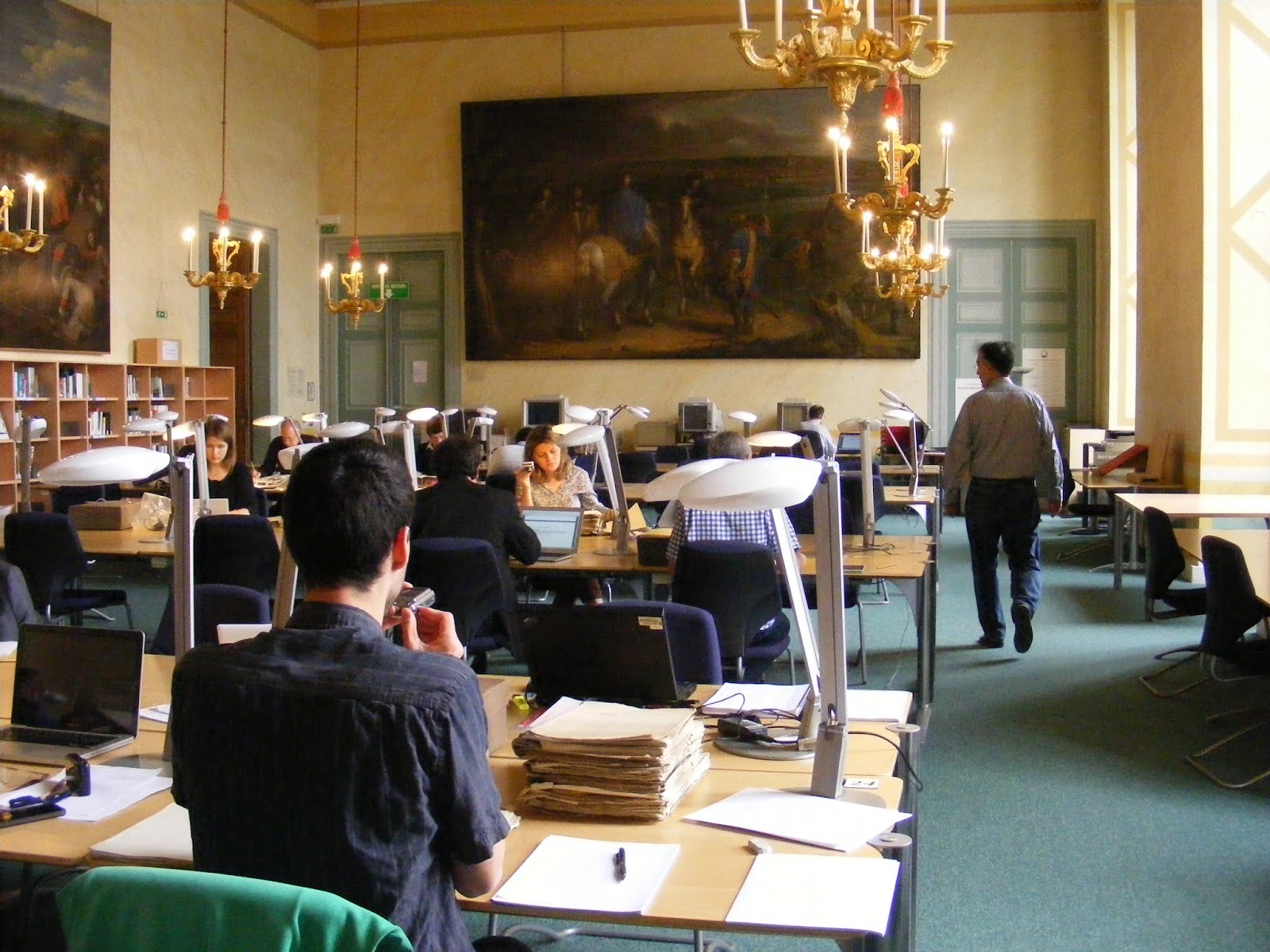
     Up two flights of wide stone stairs (remember:  it was the King’s Pavilion after all), I enter a magnificent room with classic paintings on all walls, marble columns and huge timber beams overhead.  Plus a card catalog.  (When was the last time you saw one of those?)  I explain what I’m there for and am told to take a seat until the chief research librarian is free.
     And that’s where I get lucky.  Really lucky.
     There is a colonel here today who specializes in the French troops who fought in the American Revolution.  I’m ushered into the Reading Room - complete with chandeliers - and introduced.   The colonel is mildly curious about my quest and shows me where to start.  Which turns out to be... the same book Linda consulted back in the States! 
     So ends Day 1, because I have to go pick up my long-awaited carte de séjour**. 


As the colonel told  me he won’t be around next week, I decide to go back the very next day and pick his brain some more.  Luck has placed him on my path.  That’s not an opportunity to be sneezed at.
     And there he is.  I sit down next to him, and we whisper a while about how to go about this quest.  He asks many interested questions and concludes that the dates for Soldier Charles don’t add up.  I explain Charles was over 80 when he provided this information in order to get a war pension from the American Government.  With a bit more information from me, the colonel admits that the details do make sense - the march from the landing site in Newport, Rhode Island, down to the final battle against Cornwallis in Yorktown.  But he’s adamant that no one served in both the first tour of duty with Count d’Estaing in Savannah and then a second tour of duty to fight alongside General Rochambeau of Lafayette’s troops.
     I get through half of the lengthy two-hundred-year-old army list, one name after the other, but it’s Friday and the Archives close at 4 pm (where have the two hours gone?!).  And that’s 1600 hours, not one minute more, in true military style.  At least that way I’ll miss rush hour in the Métro.

I go back several times, and see the progress on restoration of the courtyard's old paving stones.  I get some trails that don’t lead much further.  The colonel has given me his daughter’s e-mail address - he doesn’t do e-mail - and says I can contact him... which I do.  And he replies, providing additional information.
     But it doesn’t pan out.  We’ve hit a wall.  Which I guess isn’t surprising more than 200 years later.  If I had but world enough and time... as the poem says.  But I don’t.  It’s time to return to the States.
     I provide my meager gleanings to Linda back in Michigan and say I can perhaps do more.  But she’s merciful and says that information is fine.
     Before I leave, I thank her for the opportunity to see something I would never have seen otherwise.  It’s been quite an experience.


*For more on the Château de Vincennes, see my blog of May 24, 2015
** For the carte de séjour saga, see March 6, 2015

Tuesday, November 27, 2018

Out & About: Exhibits: Collections privées

Pissarro - Déchargement de bois, Quai de la Bourse

Paris has 130 museums.  In addition to the permanent collection of each, most also have temporary shows that change two or three times a year.
     So when I’m here, I have a long list of shows I want to see.  This time I have eight or nine to fit into four weeks.  I’ve already done the Ateliers Mythiques at the Musée de Montmartre and Mucha at the Musée du Luxembourg.  Today it’s the turn of the Collections Privées at the Marmottan.  And with an old friend.

Caillebotte - Pont de l'Europe

The Marmottan-Monet Museum is a perfect place for an intimate show.  Originally, it was the large home, quaintly called the “hunting lodge”, of the Duke of Valmy.  (I’m presuming he hunted in the Bois de Boulogne a mere block away.)  The lodge was later purchased by Monsieur Marmottan, whose son then gave it and his art collection to the Paris Academy of Beaux-Arts.  For many years that was the museum’s name, and it housed a lot of Impressionist art, including Monet.  Which is why decades later Claude Monet’s son Michel chose to bequeath his own collection of his father’s works to the museum... and a third M was added to the name.
     The permanent collections rule on the basement and upstairs levels.  The ground floor houses the temporary shows, as well as rooms that have some of the original furniture, period pieces to delight those interested.
     Me, I’ve come for the Collections Privées, Impressionist art owned by private individuals, artworks rarely - if ever - seen outside of these individuals’ four walls.
     Sometimes the owner of the painting was indicated, but usually not.  People don’t always want burglars to know what’s hanging in their homes.  The word “Monaco” arose often, but who knows whether it’s Prince Albert, one of his sisters, or any of the über-rich people who have paid for a residence in that tax-free principality on the Mediterranean.  Two names came up often.  One is American, the son of a grocer who hit it rich in money management:  Scott Black.  (His wife Isabelle was gallantly also named as co-owner.)  The other, Juan Antonio Pérez Simón, is a Spaniard who has lived most of his life in Mexico, made his money in telecommunications, and loves to loan his artworks out, which he’s done here.  French magazine Paris Match says his art collection is the largest in private hands in the world.

Monet - Tuileries, 1876

But on to the works themselves.
     The name Impressionism came from a painting by Monet shown in the first show ever by artists of this genre (in 1874).  Monet called it Impression, soleil levant (Impression, Sunrise).  A scoffing art critic picked up on that and said that none of the paintings in the show were real art, but only just impressions. The term stuck.  (That painting is downstairs here at the Marmottan.)
     Impressionism is all about light.  How it refracts.  How it reflects off things.  How it can transform a color.  One of the best demonstrations of this is when the artist represents dappled light, scenes with light and shadow.  One canvas by Caillebotte demonstrated this:  Le Jardin du Petit Gennevilliers.  Obviously not the center feature of the painting, three women sit off in a corner, talking in the sun.  The focus, so to speak, is on the shadows cast by the tall trees and on the walk and flowerbed, and how the fruit tree stands out against the darkness in the background.  The shadow takes up a good third of the canvas, the third that’s front and center.  The year being 1889, the work is still somewhat traditional, as paintings were, pre-photography.  It’s a scene you now might snap with your smartphone, except broken down by... light.
Toulouse-Lautrec - La Blanchisseuse
     Toulouse-Lautrec has a painting in this show that is also photographic, but it’s a portrait rather than a landscape.  He called it La Blanchisseuse (The Laundress).  It’s from the same period as Monet’s garden (1886) and shares some traits.  Here the focus seems to be on the woman’s white shirt, and the shadows its folds cast.  A far cry from Lautrec’s famous posters.  Her dreary room is made even more dreary by the contrast with the scrap of sky out her window.  Lautrec has hidden the woman’s face with a lock of hair that’s fallen over her eyes as she takes a moment out of her drudgery, and there’s the merest shadow of that lock on her cheek.  Again, light.
     Another thing that fascinated the Impressionists, something still fairly new in the world of that time, was the steam engine.  The constant morphing of the rising steam was as challenging to try to capture on canvas as was light.  Which is why so many artists set up their easels near Paris’s Gare St. Lazare train station and on the Pont de l’Europe bridge spanning the tracks.  Pissarro captured it well in another setting:  the docks, where boats wait to be loaded or unloaded.  The river gave him the additional opportunity to interpret light on the water, as well as in the sky.  As it was painted in 1898, Impressionism had already moved on a bit from a softer version of photographic depiction to something more personal, a step or two farther from reality.
Théo van Rysselberghe - Regatta
     Still later came pointillism, where light was broken down even further into dots.  Although Seurat took it to the extreme, others used it more sparingly.  There’s a canvas in this show that exemplifies that well, and it’s by an artist I hadn’t heard of:  Théo van Rysselberghe.  He called it Regatta, and the full sails of the boats embody the wind that also makes the waters choppy.  He uses that same texturing with the rocky cliffs, but in a much more subtle way.  (When I looked up van Rysselberghe, I found out he was from Belgium, and he called his style neo-Impressionism.)
Vlaminck, by Derain
     Fauvism is a school that arose from Impressionism.  That name was given by yet another art critic who focused in on the unnatural colors used by some artists and likened them to fauves (wild beasts).   André Derain painted a portrait of fellow artist Maurice de Vlaminck and the colors he chose fall within this definition, especially as one eye is blue and the other is black.  As far as impressions go, this portrait gives no more than an impression of what Vlaminck actually looked like.  Based on photos of him, it’s about as unreliable a police sketch as it could possibly be.  A mere outline of a face, with a line for a nose and only a patch of hair.  And yet, as a piece of art, it works.
     There were also a few pieces of sculpture in the show.  One was a chillingly striking head of St. John the Baptist by Rodin.  I saw one such head once in a church in Madaba, Jordan.  What’s striking here, in addition to Rodin’s mastery of the chisel, is the coldness of the white marble.  You’re sure he’s well and truly dead.  In contrast to that, there’s a child’s head by Rodin’s student - and paramour - Camille Claudel.  It’s displayed with a mirror behind it so you can stare into the child’s eyes yet see the loosely braided hair flowing down her back.  Head slightly tilted up, she seems to be waiting for something, expecting something.  The artist leaves it to us to imagine what.

There were many more artworks in this show.  But these were the ones that called out to me the most.
     And most of them will never be seen publicly again.  Unless it’s at Sotheby’s or Christie's.


Claude Monet, by Philippe Garel
Collections privées:
A voyage from Impressionist to Fauve

Musée Marmottan Monet
2 rue Louis-Boilly; 16è
Métro:  La Muette

01.44.96.50.33

Until February 10, 2019
T-Sun 10-6 / Th 10-9
Closed Mondays

11 & 7.50 €